Why National Fan Tokens Trade Differently to Club Fan Tokens
2026 is expected to be a banner year for SportFi, with wall-to-wall sporting action from January to December thanks to this summer’s World Cup (June 11–July 19).
Although the tournament is still five months away, it has been impossible to ignore the uptick in trading action for national team Fan Tokens of late. With squad selections having not yet been confirmed, traders are already getting busy laying down action according to not only nations’ World Cup prospects but the ebb and flow of sentiment based on myriad different factors.
So, are those factors the same as for club Fan Tokens? Yes, and no. Although belonging to the same asset class, there are some key differences between national team Fan Tokens and their club equivalents worth noting. Read the full article below or skip to the TL;DR at the end for the main points of difference.
Portugal National Team Fan Token ($POR) Up 32.9% in 7 Days
Before we dive into why national team Fan Tokens are distinct, a quick word on the performance of some top-performing assets since the turn of the year.
Leading the pack by seven-day price increase are the Italian National Team Fan Token ($ITA), which is up 32.6%, and the Portugal National Team Fan Token ($POR) whose value has increased by 32.9%.
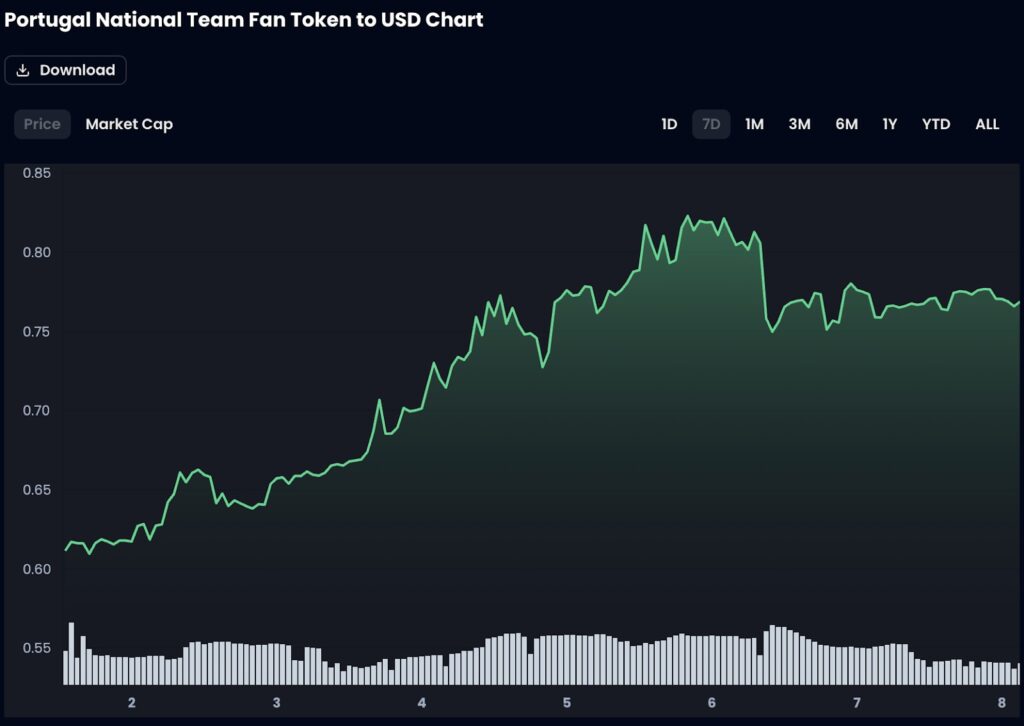
In actual fact, national team Fan Tokens have been some of the best-performing SportFi assets in the last week, with double-digit gains for the Brazil, Spain, Argentina, and Croatia tokens. All six sit comfortably inside the top ten Fan Tokens by weekly price increase.
Although these assets have attracted impressive volume, only the Argentine Football Association Fan Token ($ARG) sits inside the top ten by this metric, with 24hr volume of $1.96m – perhaps unsurprising given Argentina are the reigning world champions and have perhaps the most iconic player, Lionel Messi. (Settle down at the back there, Cristiano fans.)
Where National Fan Tokens Differ from Club Fan Tokens
So, what are the main differences between national team Fan Tokens and those issued by clubs? Well, for a start, national teams play less matches and so there are less opportunities to trade according to on-pitch events.
While club Fan Tokens often react to big wins in the league or cup competitions, with dozens of matches taking place every season, national teams typically play around ten games in an ordinary year.
Of course, there are also major events to think about, with the World Cup, European Championships, and Copa América taking place on a quadrennial basis. Another quadrennial event in the national footballing calendar is the Olympics, and the Africa Cup of Nations is biennial.
Although regular clubs play more games, the fact that opportunities to win silverware don’t come around as much for national teams, means that there is a lot riding on games at the business end of big tournaments.
If the Argentina Football Association Fan Token ($ARG) is already priced at $0.95 five months before the World Cup, with a market cap of $10.3m and 24hr volume of $1.9m, can you imagine what could happen if Messi helps the nation win another major tournament?
Of course, the sentiment around national team and club Fan Tokens is based on many of the same factors, such as injury news, recent form, and managerial appointments (naturally, clubs can sign players while national teams cannot). They can also be influenced by market dynamics and events in the wider cryptosphere, such as BTC capital inflows, Fed rate cuts, and so on.
Like their club equivalents, national team Fan Tokens unlock exclusive experiences and perks such as access to match tickets and signed memorabilia, and the availability of such perks can also reinforce positive sentiment among holders and would-be buyers.
Ultimately, national team Fan Tokens will trade differently to club Fan Tokens based on the aforementioned factors, with each helping to drive engagement in the wider SportFi space. With the Greatest Show on Earth just months away, expect trading on national Fan Tokens to intensify as it draws closer.
TL;DR Guide to National vs Club Fan Tokens
Match volume: Clubs play often; national teams play rarely.
Price triggers: Club tokens move weekly; national tokens move episodically.
Event cycles: National teams rely on major tournaments.
Game stakes: Fewer matches make each result more impactful.
Transfers: Clubs trade players; national teams don’t.
Volatility: Club tokens trend; national tokens spike.
Narratives: National tokens are driven by legacy and emotion.
Liquidity: Club tokens trade consistently; national tokens peak near events.
Engagement: Clubs offer year-round activity; national teams peak at tournaments.
Ronnie McCluskey: Fan Tokens Market Reporter